The Curriculum
9 Modules. Every Royalty.
This is the actual subject matter of the course — real 2026 rates, worked royalty math, and the exact registrations and contracts covered in each module. Pick a module to explore it in depth.
MODULE 01 / 09
Copyright & Ownership Foundations
“Every dollar in publishing flows from a right. Learn what you own.”
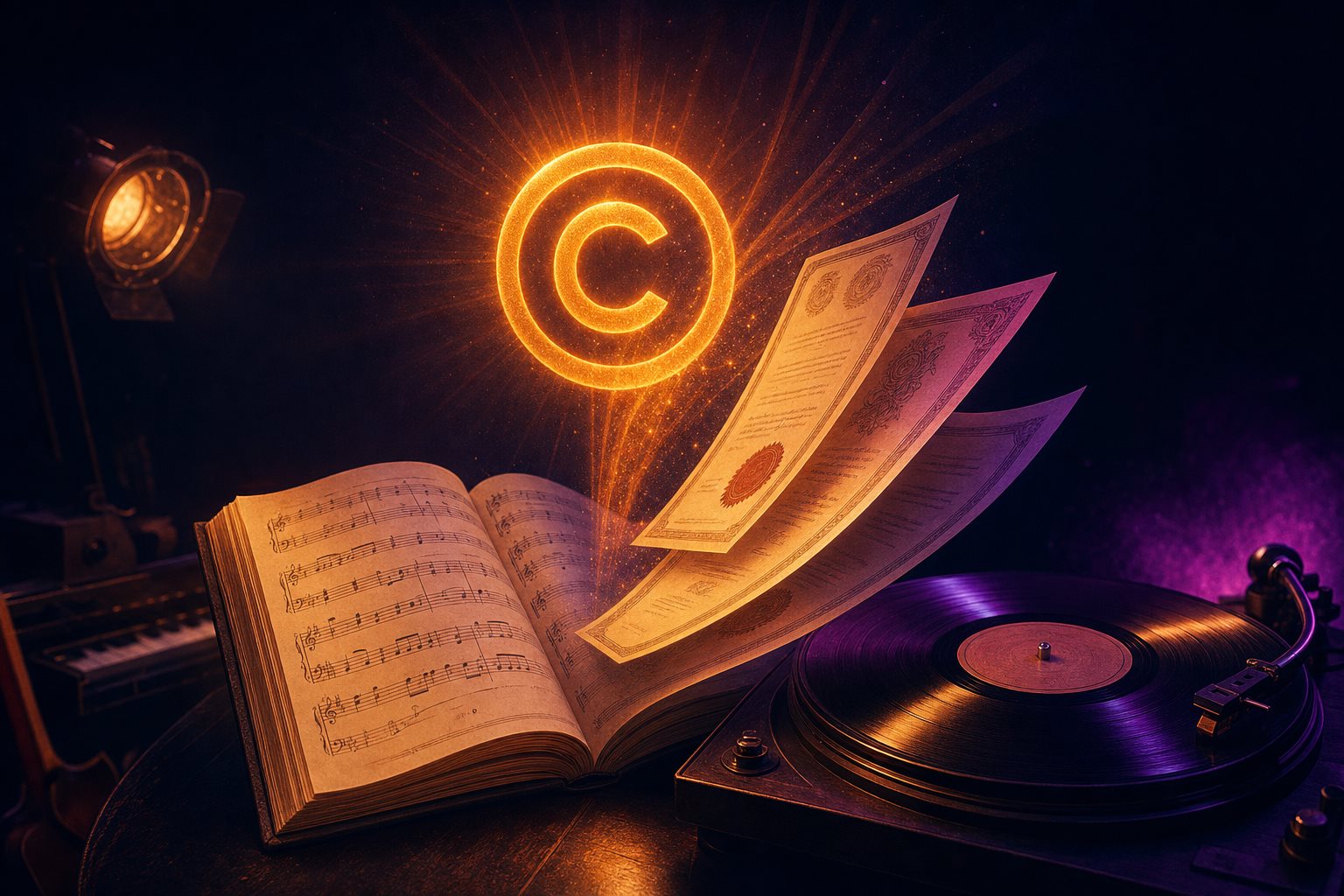
Music publishing is the business of owning and monetizing songs — not recordings, songs. Before you can collect a single royalty you need to understand exactly what you own, how ownership is created, and how the writer's share and publisher's share divide every dollar your song earns. This module builds that foundation from zero.
What you'll be able to do
- Distinguish the composition copyright from the sound recording copyright in any track
- Name the six exclusive rights copyright gives you and the royalty each one generates
- Register a song with the U.S. Copyright Office correctly (and know when it's worth it)
- Identify who legally owns a song in co-writes, producer collaborations, and work-for-hire situations
- Explain the writer's share vs. publisher's share and why 'owning your publishing' matters
The Two Copyrights in Every Song
Play any track on Spotify and you are actually hearing two separate copyrighted works stacked on top of each other. The first is the musical composition — the melody, chords, and lyrics as written. The second is the sound recording (the “master”) — that specific recorded performance of the composition. They are owned separately, licensed separately, and paid separately.
| Composition (“the song”) | Sound Recording (“the master”) | |
|---|---|---|
| What it protects | Melody, harmony, lyrics, structure | One specific recorded performance |
| Typical owner | Songwriter(s) & their publisher(s) | Recording artist & their label |
| Symbol on releases | © (copyright) | ℗ (phonogram) |
| Main royalty types | Mechanical, performance, sync (publishing side), print | Master sync fees, digital performance (SoundExchange), sales/stream revenue |
| Collected by | PROs, The MLC, publishers, sub-publishers | Labels, distributors, SoundExchange |
Worked example: “Respect”
Otis Redding wrote “Respect” in 1965 — he (and now his estate/publisher) owns the composition.
Aretha Franklin's 1967 recording is a separate master owned by her label, Atlantic Records.
When Aretha's version plays on the radio, the composition side pays Otis Redding's estate (via a PRO). In the U.S., terrestrial radio pays nothing on the master side — a famous quirk of American law.
If a film wants Aretha's recording, it needs two licenses: one from the publisher (sync) and one from Atlantic (master use). If it re-records a cover instead, it only needs the publisher.
Takeaway One song on the radio can pay the writer and not the performer. Publishing is the side that always gets paid.
What Copyright Actually Gives You: The Six Exclusive Rights
U.S. copyright law (17 U.S.C. § 106) grants the owner of a musical work a bundle of exclusive rights. Every publishing royalty stream you will ever collect traces back to someone paying for permission to use one of these rights.
- 1Reproduce the work — the source of mechanical royalties (vinyl, CDs, downloads, and the reproduction embedded in every stream).
- 2Distribute copies — bundled with reproduction in most licenses.
- 3Perform the work publicly — the source of performance royalties (radio, venues, streaming, TV) collected by PROs.
- 4Create derivative works — remixes, translations, sampling, interpolations. Nobody can legally sample your song without permission.
- 5Display the work — lyrics on screen, lyric websites, karaoke.
- 6Perform via digital audio transmission — the master-side right behind SoundExchange (relevant when you also own recordings).
- License
- Permission you grant someone to use one of your exclusive rights, usually in exchange for a royalty or fee. You keep ownership.
- Assignment
- A transfer of the copyright itself. Traditional publishing deals assign part of your copyright to the publisher. Never sign one casually.
- Compulsory license
- U.S. law forces you to let anyone cover your song once it's been commercially released — but they must pay you the statutory mechanical rate (13.1¢ per copy in 2026). You can't say no, but you always get paid.
When Copyright Exists — and Why You Still Register
Lesson 1.3 is a Pro lesson
Unlock all 9 modules, every worked example, and the full royalty playbook.
Already Pro? Sign in
Who Owns What: Joint Works, Bands & Work for Hire
Lesson 1.4 is a Pro lesson
Unlock all 9 modules, every worked example, and the full royalty playbook.
Already Pro? Sign in
The Writer's Share vs. the Publisher's Share
Lesson 1.5 is a Pro lesson
Unlock all 9 modules, every worked example, and the full royalty playbook.
Already Pro? Sign in
Duration, Public Domain & the 35-Year Reclaim Right
Lesson 1.6 is a Pro lesson
Unlock all 9 modules, every worked example, and the full royalty playbook.
Already Pro? Sign in
Read the module guides
Every module also has its own in-depth guide page — the first two lessons free to read, no account needed.
01
Copyright & Ownership Foundations
02
Splits, Shares & Songwriter Agreements
03
PRO, Publisher & MLC Registration
04
Mechanical & Performance Royalties
05
Global Sub-Publishing & Collection
06
Sync Licensing & Placement Strategy
07
Publishing Admin & Deal Structures
08
Building Your Catalog Into an Asset
09
AI & Music Publishing